Nigeria Strengthens Agricultural Mechanization Through Nationwide Training Initiative
The National Agricultural Development Fund (NADF) has officially launched the National Agricultural Mechanization Service Providers Training Programme, an ambitious initiative designed to train 4,000 tractor operators and agricultural machinery technicians across Nigeria’s six geopolitical zones.
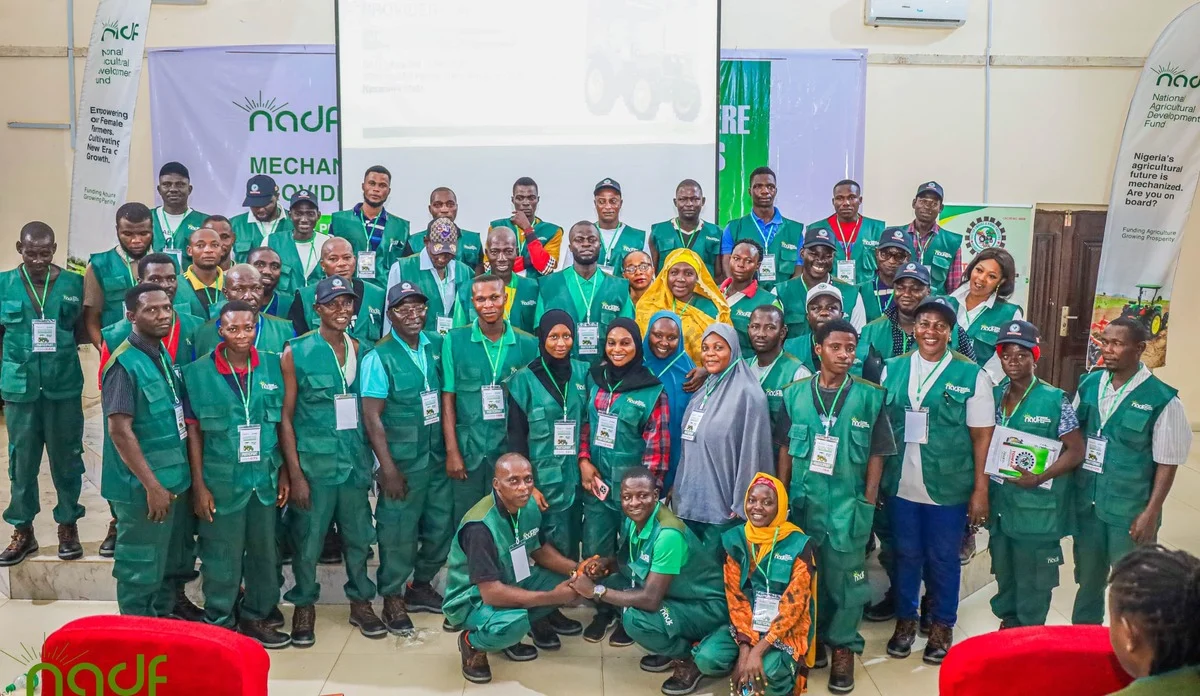
The 10-day intensive training programme marks another significant milestone in Nigeria’s drive toward modern agriculture, improved farm productivity, and sustainable food security. The first batch of 250 participants commenced training at the CSS Farms Training Complex in Gora, Nasarawa State.
The programme is being delivered in collaboration with John Deere, AGCOMS International, the Industrial Training Fund (ITF), and the Federal Ministry of Agriculture and Food Security (FMAFS). Its primary objective is to develop a highly skilled workforce capable of operating, maintaining, and managing modern agricultural equipment across the country.
Investing in Human Capital to Transform Nigerian Agriculture
Speaking during the inauguration, the Executive Secretary and Chief Executive Officer of NADF, Mohammed Ibrahim, represented by the Fund’s General Manager (Technical), Ernest Ihedigbo, described the initiative as a strategic investment in the future of Nigeria’s agricultural sector.
According to him, the programme aligns with President Bola Ahmed Tinubu’s Renewed Hope Agenda, which prioritizes agriculture as a key driver of economic diversification, employment generation, rural development, and national food security.
He noted that although Nigeria possesses enormous agricultural potential, the sector continues to face challenges such as inadequate mechanization, limited technical expertise, and insufficient access to modern farming technologies.
Closing Nigeria’s Agricultural Mechanization Gap
One of the major concerns highlighted during the launch was Nigeria’s low mechanization rate. Current estimates place the country’s tractor density at approximately 0.3 horsepower per hectare, significantly below countries like India, which records about 2.6 horsepower per hectare.
Industry experts believe that increasing access to tractors, farm implements, precision agriculture technologies, and skilled operators will substantially improve crop yields, reduce production costs, and encourage commercial-scale farming across Nigeria.
The NADF explained that while government investments in agricultural machinery are important, the long-term success of mechanization depends largely on trained professionals who can safely operate, maintain, and manage these valuable assets.
Creating Certified Tractor Operators and Agricultural Technicians
The training programme is expected to produce thousands of certified professionals equipped with practical knowledge in:
- Tractor operation and safety
- Preventive maintenance of agricultural machinery
- Precision farming techniques
- Equipment diagnostics and repairs
- Modern mechanized farming operations
- Farm equipment management
Participants were selected through recognized agricultural organizations, including the Tractor Owners and Operators Association of Nigeria (TOOAN), Tractor Owners and Hiring Facilities Association of Nigeria (TOHFAN), Women in Mechanized Agriculture (WIMA), and various Agricultural Development Projects (ADPs). The initiative also places strong emphasis on empowering women and young people within Nigeria’s agricultural value chain.
Supporting Nigeria’s 2,000-Tractor Mechanization Programme
NADF’s Head of Mechanization, Samuel Aende, explained that the training forms part of the Fund’s partnership with John Deere to support the deployment of 2,000 modern tractors across Nigeria.
By building a nationwide network of qualified operators and mechanics, the programme aims to ensure that agricultural machinery remains productive, properly maintained, and readily available to farmers.
Participants were encouraged to make the most of the opportunity by actively participating in practical sessions and acquiring the technical skills needed to become professional mechanization service providers.
READ MORE ON THIS : ARTICLE ABOUT FUNDING
Mechanization Remains the Future of Food Security
Representing the Industrial Training Fund (ITF), Fatima Baidu, Training Manager at the Model Skills Training Centre, emphasized that achieving national food security requires more than manual farming methods.
She explained that modern agriculture depends on advanced technologies operated by competent professionals capable of implementing precision field operations, following equipment safety standards, and maintaining agricultural machinery efficiently.
Similarly, Sadiq Halilu, Chief Operating Officer of AGCOMS International Trading Company Limited, encouraged trainees to participate fully throughout the programme, stressing that practical knowledge and collaboration would be critical to long-term success.
Federal Government Expands Investment in Agricultural Equipment
The Director of the Federal Department of Agricultural Mechanization, Engr. Maruf Olalekan, commended NADF for investing not only in agricultural equipment but also in developing the skilled workforce needed to sustain mechanized farming.
He disclosed that the Federal Government is implementing one of Africa’s largest agricultural mechanization programmes through the acquisition of 2,000 tractors, over 9,000 agricultural implements, and spare parts under the Nigeria-Belarus partnership. Additional support is also being provided through the Green Imperative Project in collaboration with Brazil.
He further encouraged private investors and development partners to explore opportunities in:
- Agricultural equipment leasing
- Mechanization service centres
- Farm machinery maintenance
- Precision agriculture solutions
- Local manufacturing of agricultural equipment
- Agribusiness technology and innovation
According to him, expanding mechanization services will play a vital role in improving agricultural productivity, strengthening food security, and achieving Nigeria’s long-term food sovereignty objectives.
What This Means for Nigeria’s Agricultural Future
The launch of the National Agricultural Mechanization Service Providers Training Programme represents another important step toward building a more productive, technology-driven agricultural sector. As Nigeria continues investing in modern farming equipment, tractor services, precision agriculture, and technical capacity development, the country moves closer to achieving sustainable food production and strengthening its agribusiness economy.
For stakeholders across the agricultural value chain, initiatives like this create new opportunities for improved efficiency, higher yields, job creation, and long-term agricultural development.
Keywords: Agricultural Mechanization Nigeria, Modern Farming, Farm Equipment, Tractor Services, Precision Agriculture, Agricultural Technology, Commercial Farming, Food Security, Sustainable Agriculture, Agribusiness Nigeria, Farm Machinery, Agricultural Development, Tractor Operators, Agricultural Training, Mechanized Farming.